

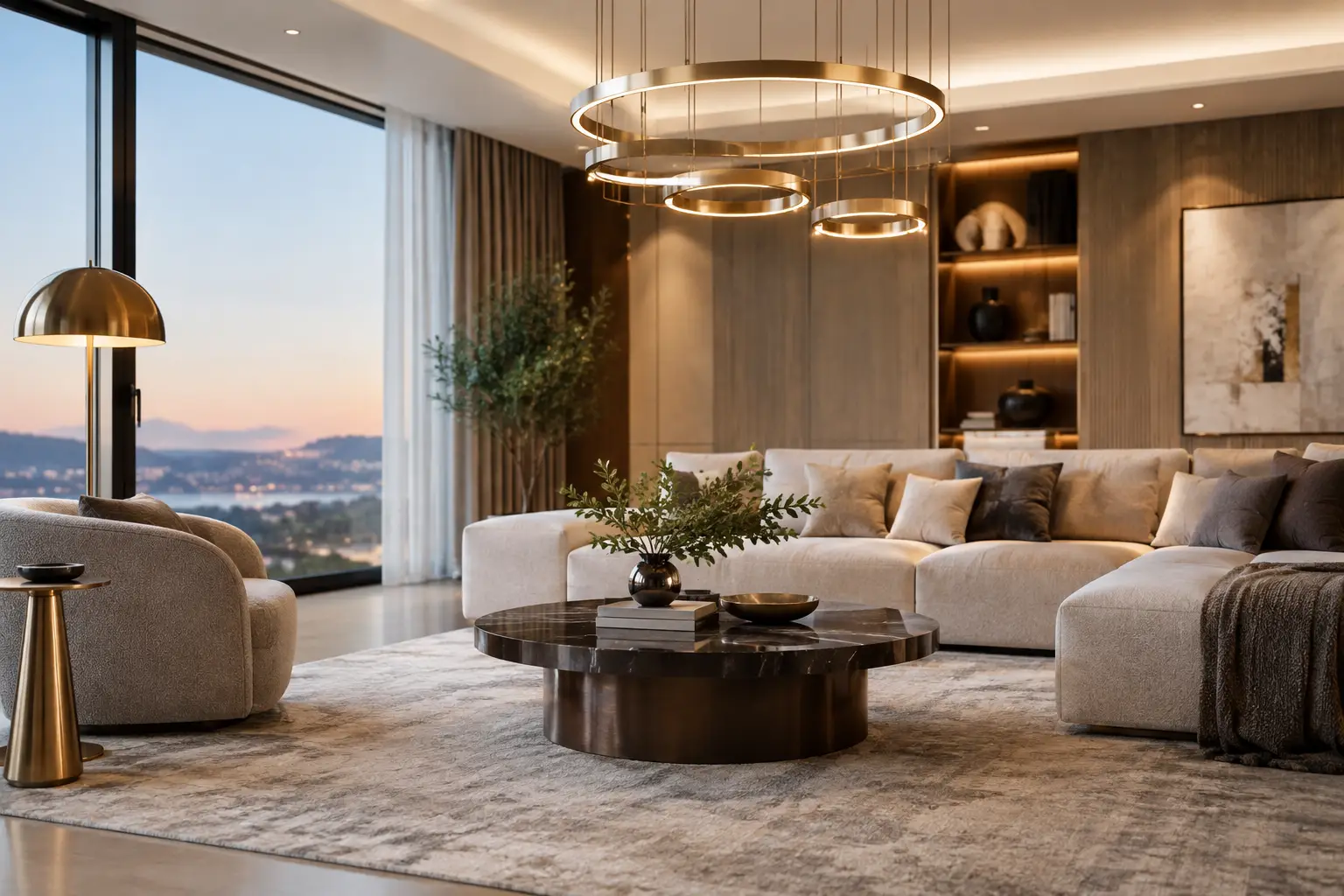
A hospitality lobby can have exceptional stonework, tailored upholstery, and custom millwork, yet still feel unfinished if its lighting lacks presence. The most influential lighting trends are not simply about selecting a fashionable silhouette. They are changing how designers use scale, material, illumination, and control to establish a memorable interior identity while meeting the practical demands of a real project.
For architects, designers, developers, and showroom buyers, the opportunity is to specify lighting that does more than fill an electrical plan. A well-chosen chandelier can anchor a double-height entrance. A sculptural pendant series can organize the experience of a restaurant dining room. A carefully layered vanity installation can make a residential bath feel composed rather than utilitarian. The strongest schemes combine visual distinction with thoughtful performance, appropriate certification, and installation-ready details.
Lighting Trends That Lead With Presence
The return to expressive, large-scale lighting continues to shape luxury residential and commercial work. Oversized fixtures are being used less as isolated statements and more as architectural elements. In a grand foyer, open-concept residence, hotel reception area, or event venue, a chandelier with substantial volume gives the eye an immediate focal point and helps define the proportions of the room.
Scale, however, should not be mistaken for excess. A fixture must relate to ceiling height, furniture footprint, sightlines, and the intensity of its light source. In a low-ceilinged dining space, a broad but shallow flush mount or linear pendant may deliver more impact than a deep chandelier. In a lobby with long viewing distances, a more dimensional composition can hold its own against expansive architectural surfaces.
Organic forms are equally prominent. Branching frames, cascading glass, petal-like forms, irregular tiers, and fluid metalwork offer a softer alternative to strict geometric lighting. These fixtures introduce movement and craftsmanship, particularly in interiors dominated by rectilinear furniture or hard surfaces. They are especially effective where a project needs warmth without losing a contemporary point of view.
Integrated LED Design Is Becoming the New Standard
Integrated LED lighting has matured into a refined design language. Rather than treating the light source as an afterthought, designers can now specify illuminated rings, acrylic diffusers, suspended lines, and layered metal profiles that make light part of the fixture’s form. The result is a clean, contemporary appearance that works well in luxury residences, offices, restaurants, and hospitality environments.
The appeal extends beyond appearance. LED-integrated fixtures can deliver efficient illumination, slim profiles, and fewer visual interruptions than conventional lamping. They are well suited to dramatic linear island lighting, architectural pendants, vanity lights, and statement ceiling fixtures where a traditional bulb would distract from the intended silhouette.
Still, integrated LED is not the only answer. LED-compatible chandeliers and sconces remain essential for projects seeking decorative lamps, a more traditional visual language, or future flexibility around lamp selection. The right choice depends on the room, the maintenance plan, desired dimming performance, and the character of the design. For a boutique guest room or residence, an LED-compatible decorative fixture may bring welcome texture and familiarity. For a contemporary corridor or large public area, integrated LED can provide the disciplined profile and consistent output the space requires.
Color temperature deserves early attention. Warm light generally supports residential, dining, lounge, and guest-room settings, while cooler or neutral temperatures can suit task-focused environments. The fixture, lamping, finish palette, and surrounding materials should be considered together. A luminous polished chrome pendant may read very differently under warm illumination than under a cooler specification.
Layered Lighting Creates More Valuable Rooms
A single central fixture rarely carries an interior by itself. One of the most practical lighting trends is the continued emphasis on layers: decorative ambient light, focused task light, accent illumination, and wall-mounted elements that add visual rhythm. This approach gives users greater control and allows a space to shift naturally from daytime activity to evening atmosphere.
In a dining room, a chandelier establishes the composition above the table, while wall sconces add depth around the perimeter. In a luxury bedroom, bedside lamps support reading and daily use, a ceiling fixture establishes ambient light, and a sculptural sconce can introduce a tailored hotel-inspired finish. In a bath, well-positioned vanity lighting reduces facial shadows that an overhead fixture alone cannot solve.
For commercial projects, layered lighting also strengthens wayfinding and comfort. Pendants may identify communal worktables, sconces can soften a corridor, and accent pieces can distinguish a lounge zone from a reception area. The design becomes more legible without relying on signage or partitions alone.
Dimming should be part of this conversation from the outset. A beautiful fixture that cannot be properly controlled may feel too bright for a dinner service or too subdued for a morning work setting. Coordinate driver compatibility, dimming systems, and local electrical requirements before finalizing specifications, particularly when multiple fixture types are being used within the same zone.
Finish Mixing Has Become More Deliberate
The era of matching every metal finish across an interior has given way to more considered contrast. Matte black, antique brass, champagne gold, polished chrome, nickel, and mixed-metal combinations are being selected for their ability to add hierarchy and depth. A warm brass chandelier can make a cool stone dining room feel more inviting. Black sconces can sharpen a pale plaster wall. Crystal details paired with a restrained metal frame can bring glamour without overwhelming a modern interior.
This is not an argument for random mixing. The strongest projects establish a finish story. A dominant finish may appear in the major decorative fixture, while a secondary finish is repeated in hardware, furniture accents, or mirror frames. The objective is coordination, not uniformity.
Material contrast matters as much as metal. Crystal continues to have a place in luxury lighting, but current applications often favor cleaner profiles, elongated drops, smoke-toned elements, or sculptural arrangements over heavily traditional ornament. Glass, alabaster-inspired diffusers, acrylic, natural textures, and finely worked metal introduce their own forms of richness. For a retail or hospitality environment, these material choices can reinforce the brand experience long before a guest notices individual furnishings.
Custom Lighting Solves the Projects Catalogs Cannot
A stocked collection offers speed and reliable design direction, but distinctive projects often call for changes in size, finish, drop length, lamping, or composition. Custom manufacturing is increasingly valuable because designers are creating interiors around precise ceiling conditions, branded environments, and furniture plans rather than adapting the entire concept to a standard fixture.
A custom chandelier may need a revised diameter for a circular reception desk, additional suspension length for a vaulted ceiling, or a finish that coordinates with a proprietary furniture package. A multi-property hospitality project may require a repeatable fixture family with variations sized for guest rooms, suites, corridors, and public spaces. These are not decorative details alone. They affect procurement, installation, maintenance, and visual consistency across the project.
The most successful custom process begins with complete information: dimensions, ceiling heights, finish references, target quantity, electrical requirements, project timeline, and the intended application. Early coordination gives the manufacturer room to advise on construction and illumination while protecting the design intent. For commercial work, certification requirements should be identified at the same stage rather than treated as a final approval item.
Bethel International supports this balance through trade-ready lighting collections and custom manufacturing capabilities for projects that require a more tailored result.
Specifying for Performance, Not Just the Presentation
Trend awareness is useful, but a fixture must perform after the photography is complete. Weight, mounting method, canopy dimensions, electrical box capacity, location rating, lamp access, replacement planning, and compliance documentation all deserve attention. These considerations are particularly important for hospitality, senior living, multifamily, and public-facing environments where fixtures operate for long hours and maintenance teams need practical solutions.
Decorative lighting should also support the furnishings it accompanies. A dramatic island fixture needs to align with the island’s length and seating arrangement. A wall sconce should relate to artwork, mirrors, headboards, or architectural reveals. A floor lamp should provide useful illumination without blocking circulation. When lighting and furniture are sourced with the same visual direction in mind, the room feels intentional from every angle.
The most enduring lighting choices are not the ones that chase novelty at any cost. They are the fixtures that give an interior a clear point of view, meet the performance needs of the application, and continue to look considered as the project matures. Specify with enough imagination to create a lasting impression and enough discipline to make every detail work.