

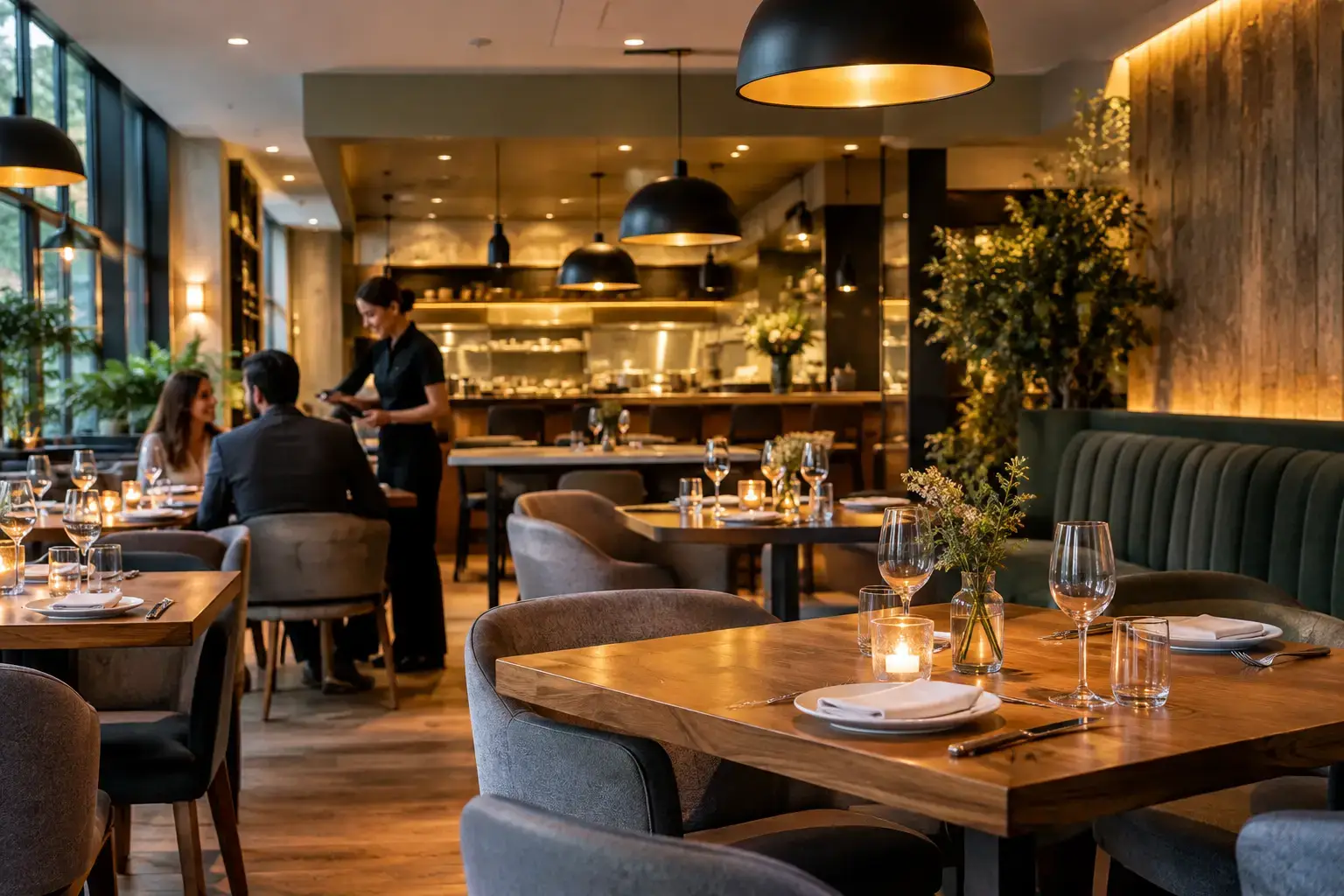
A restaurant can have exceptional food, disciplined service, and a memorable interior concept, then lose its atmosphere the moment the lighting is switched on. Learning how to layer restaurant lighting gives designers, operators, and procurement teams control over that experience. The goal is not simply to make a room brighter. It is to shape comfort, guide movement, flatter food, support staff, and make the brand feel considered from the entry to the final table.
Start With the Guest Experience
Restaurant lighting should be planned around what guests need to see, feel, and remember at different points in the visit. A fast-casual dining room, intimate steakhouse, rooftop bar, and hotel restaurant may all require different visual character, but each needs a hierarchy of light. Guests should immediately understand where to enter, where to wait, where to order, and where to settle in.
Begin with the intended mood and operating model. Lower, warmer illumination can create a sense of intimacy and occasion, but it can also make menus difficult to read and challenge staff during service. Brighter lighting communicates energy and clarity, yet an evenly bright room often feels more like a cafeteria than a destination. The strongest schemes use contrast deliberately, preserving enough illumination for comfort without treating every surface as equally important.
For hospitality projects, lighting decisions should also account for the daypart. A restaurant that serves breakfast, lunch, cocktails, and dinner should not rely on a single fixed scene. The room may need crisp, welcoming light in the morning and a more restrained, dramatic setting in the evening. Dimming and zoning make that change possible without replacing fixtures or compromising the design concept.
The Three Layers of Restaurant Lighting
A balanced restaurant design is built from ambient, task, and accent lighting. Decorative fixtures often contribute to more than one layer, but their primary job should be clear before a specification is finalized.
Ambient lighting establishes the room
Ambient lighting provides the general illumination that lets guests and staff move through the space safely. It may come from recessed fixtures, flush mounts, indirect cove lighting, ceiling-mounted decorative fixtures, or a combination of these sources. In a dining room with tall ceilings, chandeliers and large pendants can establish a more human scale while delivering a soft general glow.
Ambient light should feel consistent, not flat. Avoid placing all fixtures in a rigid grid without considering furniture placement, architectural beams, ceiling heights, and sightlines. A polished dining room needs enough overall brightness to prevent dark circulation paths, but it also benefits from gentler falloff between tables, banquettes, and perimeter walls.
For most elevated concepts, warm color temperatures tend to be more inviting than cool white light. A range around 2700K to 3000K is often appropriate for dining spaces, depending on the palette, cuisine, natural daylight, and desired brand character. Always evaluate finishes, upholstery, wall color, and tabletop materials under the selected light source. The same fixture can read very differently against dark walnut, white marble, brass, or saturated tile.
Task lighting protects function
Task lighting is the practical layer. It supports work that must be completed accurately, including reading menus, reviewing checks, preparing beverages, operating a host stand, and working in service stations. This layer is often under-planned because the visual focus remains on the dining room, yet poor task illumination becomes obvious during a busy service.
Place dedicated light at host stands, cashier positions, bars, reservation desks, pickup counters, and back-of-house work zones. In dining areas, the table itself needs enough usable illumination for guests to read without forcing the room into an overly bright setting. Carefully selected pendants above banquettes, communal tables, or private dining tables can create this practical pool of light while reinforcing the interior’s decorative language.
The trade-off is glare. A bare or exposed high-output lamp may provide ample light on a tabletop but create discomfort for seated guests, especially when the fixture sits directly in a line of sight. Diffused shades, frosted glass, fabric, alabaster-inspired materials, or thoughtfully shielded LED sources can soften output while retaining functional value.
Accent lighting builds identity
Accent lighting directs attention. It can illuminate artwork, a wine display, textured stone, decorative shelving, floral arrangements, an open kitchen, or a feature wall. This is the layer that gives a restaurant visual depth and creates photographic moments without relying on novelty.
Wall sconces are especially effective for adding vertical illumination and reducing the heavy contrast that can occur in dim rooms. They give guests a sense of enclosure, reveal finish details, and help a large room feel more composed. Adjustable accent fixtures can work well for artwork and displays, although their aiming should be coordinated early to avoid unwanted reflections on glass, polished metal, or framed pieces.
Accent lighting should be selective. When every wall, shelf, and architectural feature receives the same emphasis, nothing feels special. Identify the elements that express the concept most clearly, then use light to make those moments visible.
Plan Fixture Scale Around the Room, Not the Catalog
A fixture can be beautiful on its own and still be wrong for the restaurant. Scale should respond to ceiling height, table dimensions, circulation clearances, and the room’s visual density. Oversized chandeliers can create drama over a central dining zone or bar, while smaller pendants may provide rhythm above a run of booths or a chef’s counter.
Consider the view from every important seat. A low-hanging decorative pendant may define a table beautifully, but it should not block sightlines across the room or place an exposed source at eye level. In high-traffic areas, fixtures must also stay clear of doors, staff paths, and service equipment.
Material selection matters as much as silhouette. Crystal, metal, glass, rattan, fabric, and contemporary LED forms each affect how light is distributed and how the restaurant reads after dark. A layered scheme often benefits from contrast: sculptural statement fixtures for visual presence, quieter architectural lighting for coverage, and wall-mounted pieces for warmth and dimension.
Use Controls to Match the Pace of Service
Even the best fixture package will underperform without thoughtful controls. Divide the restaurant into independently controlled zones, such as the entry, bar, main dining area, private room, waiting area, restrooms, and exterior approach. This enables staff to adjust one zone without changing the entire guest environment.
Dimming should be compatible with the specified LED drivers, lamps, and control system. This is a technical coordination point worth resolving before installation. Incompatible components may flicker, drop out at low levels, or dim unevenly, all of which diminish a luxury setting.
Pre-programmed scenes simplify daily operation. A morning scene can emphasize clarity and cleanliness, while dinner service can lower ambient output and preserve emphasis on tables, walls, and decorative focal points. Closing and cleaning scenes should provide sufficient light for staff without requiring manual adjustment of every circuit.
Account for Compliance, Maintenance, and Procurement
Restaurant lighting is not solely a decorative purchase. Commercial projects need to account for local code requirements, emergency lighting, energy standards, mounting conditions, cleanability, replacement access, and product approvals. Decorative fixtures should be specified with the appropriate certifications and documentation for the project jurisdiction.
Maintenance deserves early attention. A chandelier over a banquette may be visually compelling, but can the team safely access it for cleaning and service? In open kitchens or bars, grease, steam, and frequent cleaning can affect fixture materials and finishes. Specify products suited to the environment, and retain extra lamps, drivers, or replacement components when the design depends on a particular finish or source.
For multi-unit hospitality groups and new developments, consistency of supply is equally important. Stocked collections can support faster timelines, while custom manufacturing can address a distinctive scale, finish, dimension, or configuration. The right approach depends on lead time, quantity, budget, and how essential the fixture is to the brand concept.
A Better Way to Review the Lighting Plan
Before approving a restaurant lighting package, review the scheme after dark and from a guest’s eye level. Ask whether the entrance feels welcoming, whether tables are comfortable to occupy, whether servers can move safely, and whether the room has a focal point. Then review the same plan in daylight, when window glare and exterior conditions can change the balance substantially.
Mockups are valuable for signature areas. Testing one pendant above a table, one wall sconce on the selected finish, or a section of cove lighting can prevent expensive revisions later. It also gives the design team an opportunity to assess dimming quality, glare, color rendering, and the relationship between lighting and furnishings.
A successful restaurant lighting plan does more than illuminate the room. It gives the concept a visual cadence that guests may not consciously identify, yet immediately feel. With layered sources, considered controls, and specification-ready decorative lighting, a restaurant can remain functional through every service while presenting the level of luxury and distinction guests return for. For projects requiring a tailored scale or finish, Bethel International can support a coordinated lighting direction from statement fixture to contract-ready detail.