

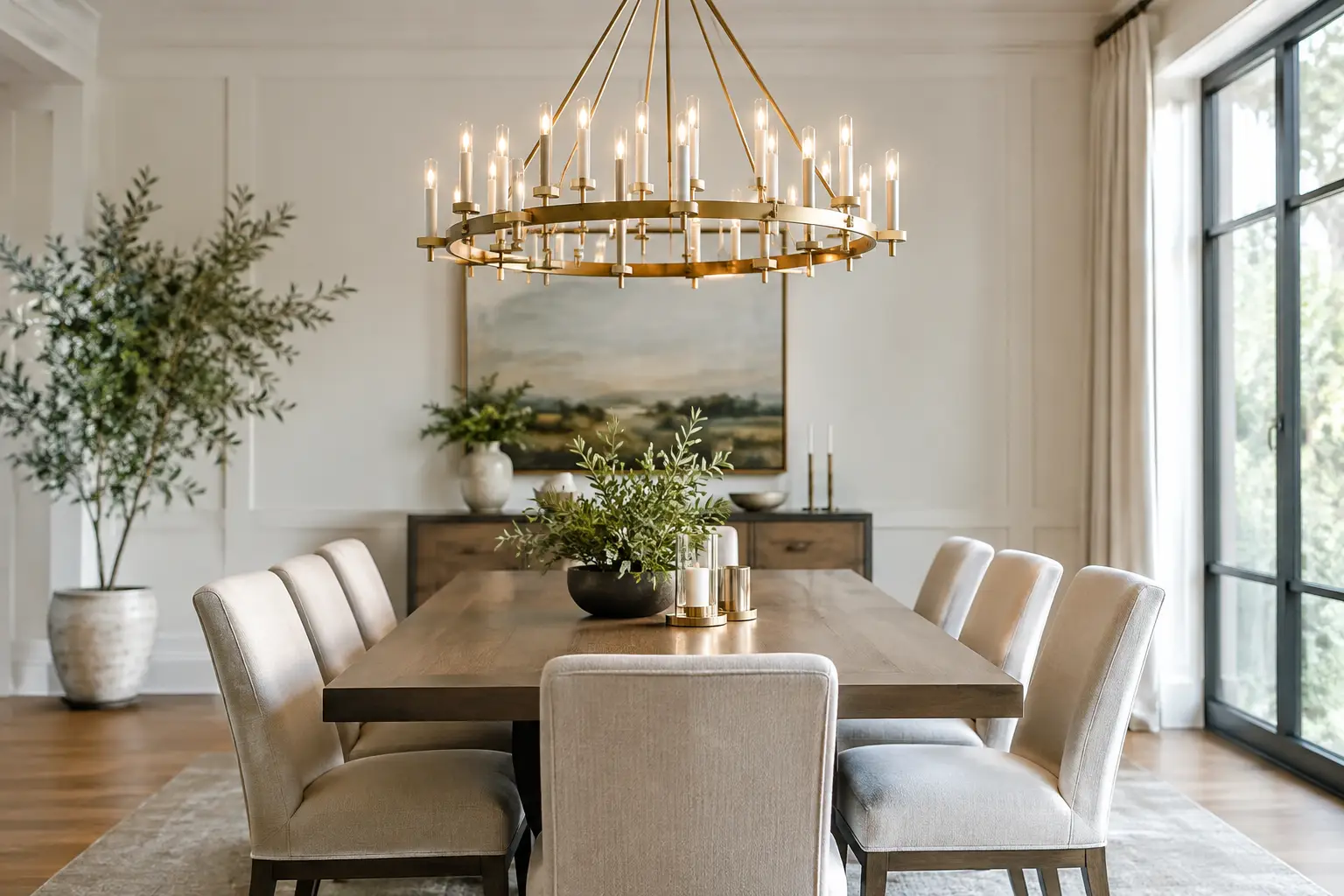
A dining room chandelier has one job before dinner is ever served: it must establish the room’s point of view. The most successful modern dining room chandeliers do more than provide illumination over a table. They organize sightlines, give scale to an open plan, reinforce the material palette, and make an ordinary dining setting feel intentionally composed.
For design professionals, retailers, and hospitality buyers, that makes chandelier selection a specification decision as much as an aesthetic one. A compelling silhouette may win approval in a presentation, but the final fixture must also deliver appropriate light, suit the ceiling condition, coordinate with furnishings, and meet the expectations of the project type. The right choice balances visual presence with real-world performance.
Why Modern Dining Room Chandeliers Lead the Design
Contemporary dining spaces often rely on fewer decorative elements than traditional interiors. Clean-lined furniture, architectural finishes, and expansive glazing can create a refined backdrop, but they also make every major selection more visible. A chandelier becomes the element that gives the dining zone hierarchy.
Modern designs accomplish this in different ways. A linear LED fixture can echo the length of a walnut table and lend crisp structure to a condominium dining area. A cascading glass composition can introduce depth and movement above a round table in a hotel restaurant. Sculptural metal arms, alabaster-inspired shades, crystal elements, or mixed finishes can bring a layer of luxury without returning the room to a heavily traditional look.
The strongest installations are not always the largest. In a compact dining room, an overly broad fixture can make the table feel crowded and lower the perceived ceiling height. In a grand space, a modest pendant can disappear entirely. The chandelier should hold its own against the room’s volume, the table’s proportions, and the visual weight of surrounding furniture.
Start With Scale, Not Style
Style is often the first consideration in a showroom or design review, but scale should be resolved first. It is the difference between a beautiful fixture and a complete composition.
For a rectangular dining table, a linear chandelier generally works best when it is approximately one-half to two-thirds the table’s length. This keeps the fixture visually centered over the dining surface while leaving enough breathing room at either end. On a round table, a centered circular, clustered, or tiered fixture often creates a more natural relationship with the furniture footprint.
A useful starting point for dining rooms is to add the room’s length and width in feet, then use that number in inches as a rough chandelier diameter. A 14-by-16-foot room, for example, may support a fixture near 30 inches wide. This is a guide, not a rule. Ceiling height, table size, adjacent living areas, and architectural features can all justify a different proportion.
Hanging height matters just as much. In most residential settings, the bottom of a chandelier should sit about 30 to 36 inches above the tabletop. Higher ceilings may call for additional height, particularly when the fixture has a substantial vertical profile. In restaurants, private dining rooms, and event venues, clearance, guest comfort, and staff circulation deserve close attention. A fixture cannot feel luxurious if it interrupts conversation or becomes an obstacle during service.
Consider the View Beyond the Table
Dining rooms are rarely experienced from one fixed position. In open-concept residences, the chandelier may be visible from the entry, kitchen, living room, or upper stair landing. In hospitality settings, it may be part of the first impression from a lobby or corridor.
Review the fixture in elevation and from long sightlines. A minimal horizontal form may look exceptional directly over the table but appear nearly invisible from an adjoining room. Conversely, a dramatic multi-tier chandelier can create a memorable focal point from several vantage points, provided the ceiling volume can support it. This is where a chandelier shifts from an object to an architectural feature.
Match Light Output to the Dining Experience
A dining room needs flexible light, not simply more light. The setting must support place settings, menus, food presentation, and conversation while retaining a comfortable, flattering atmosphere. A decorative chandelier should be planned alongside recessed lighting, wall sconces, or perimeter illumination when the room requires layered control.
LED-integrated chandeliers offer clean forms, energy efficiency, and the ability to create continuous lines of light without visible bulbs. They are particularly effective in contemporary residences, multifamily developments, and commercial interiors where a streamlined appearance and efficient operation are priorities. LED-compatible chandeliers, on the other hand, can be preferable when a project calls for replaceable lamps, a more traditional lighting expression, or specific lamping flexibility.
Color temperature should align with the intended mood and the surrounding finishes. Warm white light, commonly in the 2700K to 3000K range, is often the natural choice for residential dining and upscale hospitality because it complements wood, stone, fabrics, and skin tones. Cooler temperatures can feel appropriate in some contemporary commercial environments, but they may make a dining room feel less inviting if used without balance.
Dimming is not an upgrade to reserve for premium projects. It is central to how dining spaces function. Bright light supports setup, cleaning, and daytime use; lower levels create a more intimate evening setting. Confirm dimmer compatibility, driver requirements for integrated LED fixtures, and control-system coordination early in the specification process. These details prevent expensive adjustments after installation.
Select Finishes That Support the Whole Room
Modern lighting does not require a single finish or a strictly monochromatic scheme. In fact, a carefully selected chandelier can connect several finishes already present in the space. Brushed brass can warm up dark wood and creamy stone. Matte black can sharpen a palette of pale oak, plaster, and linen. Polished chrome or nickel can complement cooler, more tailored interiors. Crystal and glass introduce sparkle, but their effect depends on density, shape, and the light source behind them.
The trade-off is visibility. High-contrast finishes create a stronger statement, which is ideal when the chandelier is meant to anchor the room. Low-contrast finishes blend more quietly into the architecture and allow furniture, art, or a dramatic table to carry greater attention. Neither approach is inherently better. The decision depends on where the project needs its visual energy.
Material selection also has practical implications. In restaurant, hotel, and senior-living projects, ease of maintenance should be part of the design conversation. Highly articulated fixtures and dense crystal compositions can deliver exceptional impact, but they require a realistic cleaning plan. For high-traffic spaces, a design with accessible surfaces and durable finishes may offer greater long-term value.
Modern Dining Room Chandeliers for Contract Projects
Contract lighting introduces requirements that extend beyond residential scale and style. Hospitality procurement teams and commercial project managers must evaluate product dimensions, weight, mounting conditions, lead times, replacement needs, and applicable certifications. A fixture specified for a high-visibility public space should be as dependable operationally as it is distinctive visually.
When working across multiple rooms or properties, consistency is valuable, but repetition does not need to look generic. A coordinated family of chandeliers, pendants, sconces, and vanity lighting can establish a recognizable design language while allowing each area to retain its own identity. For example, a lobby may feature a large custom chandelier, while dining areas use complementary linear forms and private rooms receive smaller-scale versions in the same finish family.
Custom manufacturing becomes especially useful when standard dimensions, finishes, suspension lengths, or lamping options do not satisfy the design brief. It can help a fixture respond to unusually long communal tables, double-height dining rooms, branded hospitality concepts, or a specific palette developed for a residential model unit. The key is to begin custom discussions early enough to account for engineering, approvals, production, and installation coordination.
Bethel International supports this project-led approach with a broad wholesale assortment and custom lighting capabilities designed for residential, hospitality, and commercial interiors. For trade buyers, the most productive selection process combines visual direction with complete fixture information from the start.
Specify the Details Before the Order Is Placed
A chandelier can look resolved in a rendering and still create problems in the field if the project team has not confirmed the installation details. Verify fixture weight and junction-box support, suspension method, canopy dimensions, overall drop, voltage, and driver location where applicable. For fixtures with adjustable cables or stems, establish the intended installed height before final trimming.
It is also wise to review how the chandelier performs alongside ceiling sprinklers, HVAC grilles, beams, coffers, and artwork. In a dining room with a centered table but an off-center electrical box, a fixture with flexible mounting or a planned electrical relocation may be necessary. These are small decisions on paper and highly visible decisions after drywall is complete.
For multi-unit residential and hospitality installations, keep finish samples and approved cut sheets aligned across the design, procurement, and construction teams. A substitute that appears similar online may differ significantly in scale, glass tone, metal sheen, or LED color quality. Protecting the approved design intent is often worth more than a last-minute compromise.
The best chandelier choice gives a dining room a sense of occasion without making the room work too hard. When proportion, illumination, finish, and installation are considered together, the fixture becomes more than a centerpiece. It becomes the element guests remember when they remember the room.